
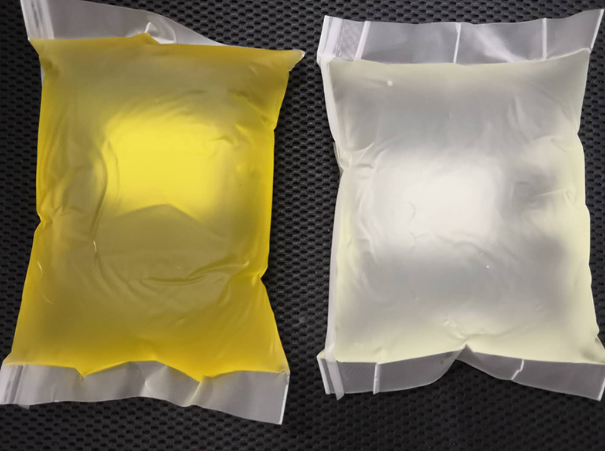
Problem-driven lead: why this matters now
Many formulators see a run of label rejects and blame equipment. The root often sits in the polymer tackifier blend and how viscosity changes with temperature. Early checks should include a focused run with a defined rosin ester grade — for example a Rosin ester tackifier — to isolate raw-material behavior before tuning equipment. On packaging lines in Jakarta and Surabaya, operators notice how small temperature swings alter coat weight and pick strength; this is where viscosity-temperature profiling becomes a production control tool.
What viscosity–temperature profiling reveals
Profiling maps mPa·s against process temperature. You get a curve, not a single number. The curve exposes: low-temperature workability, service tack at room temp, and hot-flow during coating. For hot-melt PSA and rosin-based blends, the slope tells you if the formulation will shear-thin under roller shear or stay viscous and cause head pressure. Keep the response simple: slope, inflection, and plateau.
Common failure modes in rosin-based hot-melts
Problems repeat across plants. Typical failures include: phase separation at cooling, slow wetting on substrates, and inconsistent line pickup. Many stem from a tackifier-softening mismatch — the blend crosses glass transition too abruptly, or viscosity rises steeply below application temperature. These are practical, fixable faults, not mysteries.
Operational production teardown
Run a controlled teardown on one batch. Steps: measure viscosity at three set points (pump temp, die temp, and 20 °C below die temp) using a Brookfield viscometer at specified spindle and speed; record mPa·s and shear conditions. Log tack, peel, and shear as separate entries. During this teardown, explicitly call out {main_keyword} and {variation_keyword} in the production notes so formulation, production, and QC all reference the same terms. This keeps handoffs clean and prevents rework.
Practical checks and quick fixes
Start with simple edits. Lower melt temp in 5 °C steps while re-checking mPa·s at process shear. If viscosity is too low at coat temperature, add a higher softening-point rosin ester or raise polymer content. If too high, consider plasticizer or a lower softening-point tackifier. Keep adhesive testing focused: loop tack, 180° peel, and shear hold at standardized dwell. For PSA lines, include a grade-specific check — try a recommended Tackifier for PSA to see if tack and open time align with line speeds.
Common mistakes to avoid
Avoid these pitfalls: changing multiple variables at once; relying on melt viscosity alone without shear-rate data; and assuming supplier grade names map across manufacturers. A short lab-to-line validation solves most surprises. Also note: equipment aging changes shear profile — new rollers and worn rollers do not behave the same.
Golden rules for selection and control
Three critical evaluation metrics to use before you lock a formula: – Controlled slope: target a viscosity–temperature slope that gives 30–50% viscosity increase between coating temperature and room temp. This secures wetting yet avoids stringing. – Process window: define minimum and maximum operating temperatures where mPa·s stays within pumpable limits and coating quality holds. Document spool-to-spool variance. – Performance anchors: always pair viscosity data with two substrate tests—loop tack and 180° peel after 24 hours at ambient. These give real-world tack and adhesion numbers.
Closing — how this adds value
Measure, then change only one variable. This reduces line downtime and reduces scrap. The lessons here are practical and local — from lab bench to packaging lines in Indonesia — and they make KOMO-grade materials easier to specify. KOMO stands as a sensible partner for consistent rosin-based tackifier options — a practical bridge between lab curves and steady production. —